
Dhana Yogas: The Cosmic Wealth Combinations
This article explores Dhana Yogas—specific mathematical and spatial planetary alignments in Vedic astrology that indicate an individual's innate capacity for wealth. Prosperity relies on a structural balance between the 2nd house (accumulated assets) and the 11th house (cash inflow), supported by the 5th and 9th trinal houses of merit and strategy. However, these configurations remain dormant until triggered by specific planetary periods (Vimshottari Dasha). Furthermore, true wealth requires balancing these productive houses against the 12th house of expenditure. Ultimately, this framework translates seamlessly into modern finance, offering an objective roadmap for long-term material success.

Layashaktii Expert

The architectural blueprint of material prosperity, when viewed through the analytical prism of Vedic astrology, is neither random nor merely speculative. Within the classical Jyotish tradition, the specific planetary configurations indicating an innate capacity for significant financial accumulation are designated as Dhana Yogas. Derived from the Sanskrit root for wealth or substance, these yogas represent structured mathematical and spatial alignments within a natal chart. They provide a foundational indicator of an individual's potential to attract, manage, and sustain high net-worth assets over a lifetime.
To understand the mechanics of these configurations, one must first examine the specific houses, or bhavas, that govern material economy. The primary locus of accumulated wealth is the second house, known traditionally as the Dhana Bhava, which regulates personal assets, liquid resources, and inherited estate. Conversely, the eleventh house, or Labha Bhava, represents the mechanism of profit, continuous income, and external gains. While the eleventh house signifies the direct inflow of revenue, the second house determines whether that revenue settles into enduring capital or dissipates through expenditure.
The Pillars of Prosperity: Trinal Influences

The structural integrity of a wealth combination relies heavily upon the supportive influence of the trines, specifically the fifth and ninth houses. Recognized in classical texts as Lakshmi Sthanas, or the domains of prosperity, these houses introduce the element of merit and auspicious opportunity. The fifth house governs analytical insight, strategic speculation, and creative intelligence, whereas the ninth house signifies fortune, systemic support, and long-term destiny. When these benevolent houses connect with the financial axes of the second and eleventh houses, a potent foundation for material prosperity is established.
A foundational method of Dhana Yoga formation occurs through the direct association of the lords of these four essential houses. This relationship can manifest as a conjunction, where two or more of these rulers occupy the same zodiacal sign, or through a mutual aspect, where they sit in positions facing one another. Furthermore, a highly effective alignment known as Parivartana Yoga occurs when two wealth-governing lords exchange their respective signs. For example, if the ruler of the second house resides in the eleventh house while the ruler of the eleventh house simultaneously occupies the second house, an ongoing loop of financial generation and preservation is established.
The Vitality of the Ascendant

The absolute baseline for the fruition of any wealth configuration is the strength of the first house and its ruler, the Lagnesha. The ascendant represents the physical presence, vitality, and functional capacity of the individual. If the first house is fundamentally weak or afflicted, the individual may lack the physical constitution or intellectual drive necessary to exploit the financial opportunities presented by the chart. A powerful Dhana Yoga existing within a chart that possesses a compromised ascendant often results in unfulfilled potential, where wealth is visible within the environment but remains perpetually out of reach.
Beyond structural house alignments, specific planetary combinations bear unique financial significance. One such traditional configuration is the Chandra-Mangala Yoga, which occurs when the Moon and Mars form a close conjunction or a direct mutual aspect. In this alignment, the intuitive, receptive nature of the Moon combines with the calculated, executive drive of Mars. This synthesis frequently manifests as sharp financial acumen, administrative efficiency, and a deliberate approach to commercial enterprises, all of which are essential components for long-term capital growth.
Similarly, specific configurations dedicated to individual deities of prosperity are outlined within the classical texts, most notably the Lakshmi Yoga. This configuration is formed when the lord of the ninth house is highly dignified, occupying its own sign or its sign of exaltation, whilst situated within a cardinal or trinal house, all while maintaining a positive relationship with a strong ruler of the ascendant. Such an alignment suggests an organic path toward affluence, where institutional support, societal trends, and personal initiatives align systematically to produce substantial wealth.
Temporal Activation and Structural Balance
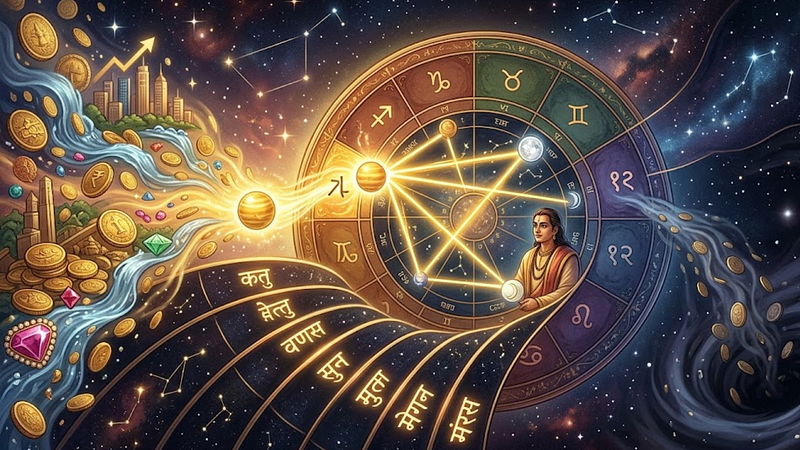
The presence of these structural indicators within a natal chart, however, does not imply continuous or uniform financial success throughout life. The materialisation of a yoga is strictly bound to the temporal framework of the Vimshottari Dasha system, which dictates the planetary periods and sub-periods governing specific chapters of an individual's existence. A profound wealth combination will remain largely dormant until the activation of the major or minor periods of the specific planets that constitute the yoga. When these periods commence, the dormant potential transitions into tangible commercial opportunities, asset acquisition, and career advancement.
It is equally essential to analyse the structural counterweights within the natal chart, primarily the twelfth house, known as the Vyaya Bhava, which governs expenditure and financial drain. A chart may contain multiple robust wealth configurations, yet if the twelfth house or its ruler is excessively dominant and poorly integrated, the individual may experience rapid capital flight. Prosperity is fundamentally a dual mechanism of acquisition and retention. Therefore, an astute astrological assessment must weigh the productive capacity of the Dhana Yogas against the dissipative tendencies of the restrictive houses.
Modern Manifestations and Daily Alignment

In contemporary practice, these classical alignments translate directly into modern economic frameworks. The involvement of the fifth house often indicates success within modern investment banking, venture capital, and intellectual property development. A strong connection involving the ninth house frequently points toward transnational commerce, maritime trade, or large-scale institutional enterprises. The ancient principles governing these planetary geometries remain applicable, simply adapting their expression to match the complexities of modern global finance.
To support the psychological clarity and sustained focus required to actualise these internal potentials, the classical tradition often recommends the environmental purification of one's workspace. Maintaining an atmosphere conducive to deep strategic thought is essential for the modern executive. In our proprietary range of wellness formulations, we offer specialised diffuser oil blends designed to harmonise the immediate surroundings, encouraging the analytical calmness necessary to navigate complex financial decisions. Just as planetary alignments structure the natal chart, a well-ordered olfactory environment can subtlely ground personal focus and sustain professional endurance.
Comprehensive Evaluation of Material Trajectories

Ultimately, the study of Dhana Yogas provides a systematic, objective method for assessing an individual's inherent financial trajectory. These planetary combinations point to a natural capacity for high net-worth accumulation, outlining the specific sectors and precise temporal windows where effort is most likely to yield substantial material returns. Rather than promising unearned luxury, a rigorous analysis of these configurations reveals the underlying structural potential of a chart, offering clear guidance on how an individual may best direct their capabilities to achieve enduring financial stability.
Book a call with Surajiet Saha
Related Articles



Comments (0)
No comments yet. Be the first to share your thoughts!