
The Mythology of the Self-Made Man: A Critique Through the Lens of Dharma
The modern narrative of the self-made man falsely isolates individual achievement from its societal and historical foundations, presenting a distorted view of human autonomy. By examining this construct through the classical Indian lens of Dharma, one uncovers a profound philosophy of interconnectedness, or Sambandha. Human success is not an isolated phenomenon; rather, it is a cultivated outcome supported by an intricate network of communal, ancestral, and environmental forces. Acknowledging these invisible dependencies, particularly through frameworks like the Mahayajna, shifts the focus from egoistic accumulation to a mature, responsible, and sustainable paradigm of prosperity.

Layashaktii
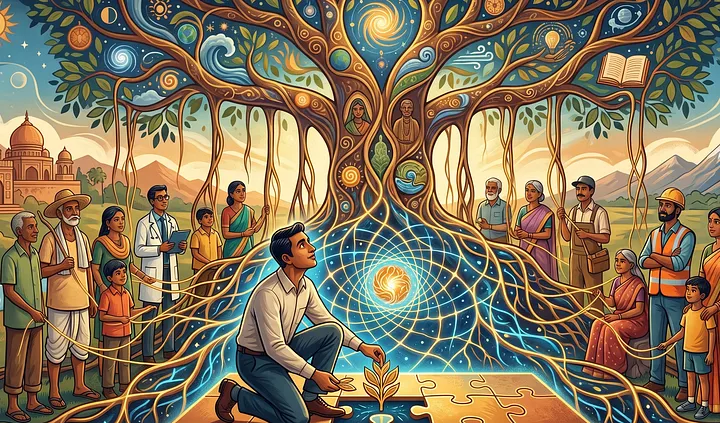
The Mythology of the Self-Made Man: A Critique Through the Lens of Dharma
The concept of the 'self-made man' has long served as a cornerstone of modern individualistic philosophy. It posits that a person’s success is the exclusive result of their own ambition, industriousness, and internal fortitude. While this narrative offers a compelling sense of agency, it often overlooks the intricate tapestry of external factors and communal support that sustain any individual life. From a scholarly perspective informed by Indian intellectual traditions, specifically the concept of Dharma, the notion of a completely autonomous, self-originated success appears not only incomplete but fundamentally illusory.
The Illusion of Autonomy
The modern celebration of individualism frequently isolates the person from their historical and social context. By focusing solely on the 'will' of the individual, one ignores the inherited infrastructure of knowledge, the stability of civic institutions, and the silent contributions of the preceding generations. This perspective suggests that the individual exists in a vacuum, yet no person creates the language they speak, the scientific principles they apply, or the legal systems that protect their ventures.
To claim the title of 'self-made' is to disregard the essential truth of human contingency. It is a narrative that rewards the ego whilst obscuring the vast network of dependencies that make achievement possible. In the absence of a collective framework, the individual effort would lack both the means of execution and the theatre of operation.
Dharma and the Principle of Interconnectedness
In contrast to the atomised view of the self, the framework of Dharma offers a more nuanced understanding of a person’s place in the world. Often translated as 'duty' or 'righteousness', Dharma refers to the inherent order of the universe and the reciprocal obligations that bind all entities. Within this tradition, the individual is seen as a node within a cosmic and social web, rather than a solitary actor.
The pursuit of excellence is not viewed as an isolated triumph, but as the fulfilment of one's role within a larger system (Rta). Success, therefore, is never a purely private acquisition; it is a manifestation of the support provided by the family, the community, and the environment. When one acknowledges these ties, the myth of the self-made man dissolves into a more profound realisation of Sambandha, or interconnectedness.
The Debt of Existence: The Five Great Sacrifices
Classical Indian thought further dismantles the idea of self-sufficiency through the concept of Mahayajna, or the five great sacrifices. These duties remind the individual that they are born into a state of perpetual debt to various sources:
Pitri Yajna: Acknowledging the biological and cultural heritage provided by one's ancestors.
Deva Yajna: Recognising the elemental and environmental forces that sustain life.
Rishi Yajna: Honoring the sages and scholars whose intellectual labour provides the foundation for current knowledge.
Nri Yajna: The duty toward fellow human beings and the broader society.
Bhuta Yajna: The responsibility toward the non-human world and the ecosystem.
When these obligations are properly understood, the individual ceases to see themselves as the sole architect of their fortune. Instead, they become a steward of resources and wisdom that have been facilitated by countless others.
Toward a More Mature Prosperity
A critique of the self-made myth does not aim to diminish personal effort or merit. Hard work and intelligence are indeed necessary components of achievement. However, intellectual honesty requires that we balance the account of personal effort with the acknowledgment of communal and systemic support.
By shifting the focus from the 'self-made' ideal to a 'Dharma-centred' understanding, society can cultivate a more grounded sense of gratitude and responsibility. This perspective encourages a form of success that is inclusive rather than exclusionary, acknowledging that our highest achievements are made possible only because we stand upon the shoulders of a collective past and a cooperative present. True prosperity, in this light, is not a trophy of the isolated self, but a contribution to the enduring harmony of the whole.

Comments (0)
No comments yet. Be the first to share your thoughts!