
The Antiquity of Indian Fragrance: Sacred and Ritualistic Foundations
The tradition of Indian perfumery represents a sophisticated convergence of sacred ritual, classical science, and imperial patronage. From the Vedic fire sacrifices that utilized aromatic resins for environmental and spiritual purification, the practice evolved into a disciplined science documented in classical texts such as the Gandhashastra and Brihat Samhita. Under Mughal administration, the refinement of hydro-distillation techniques established a courtly culture of luxury centred on non-alcoholic, oil-based distillates. The city of Kannauj emerged as the definitive geographical locus of this industry, preserving the traditional deg-bhapka process to capture complex environmental profiles like Attar Mitti. In the contemporary era, the traditional attar bottle stands as an authentic, sustainable alternative to Western synthetic fragrances, navigating modern regulatory frameworks whilst preserving an ancient olfactory heritage.

Amolendu H.
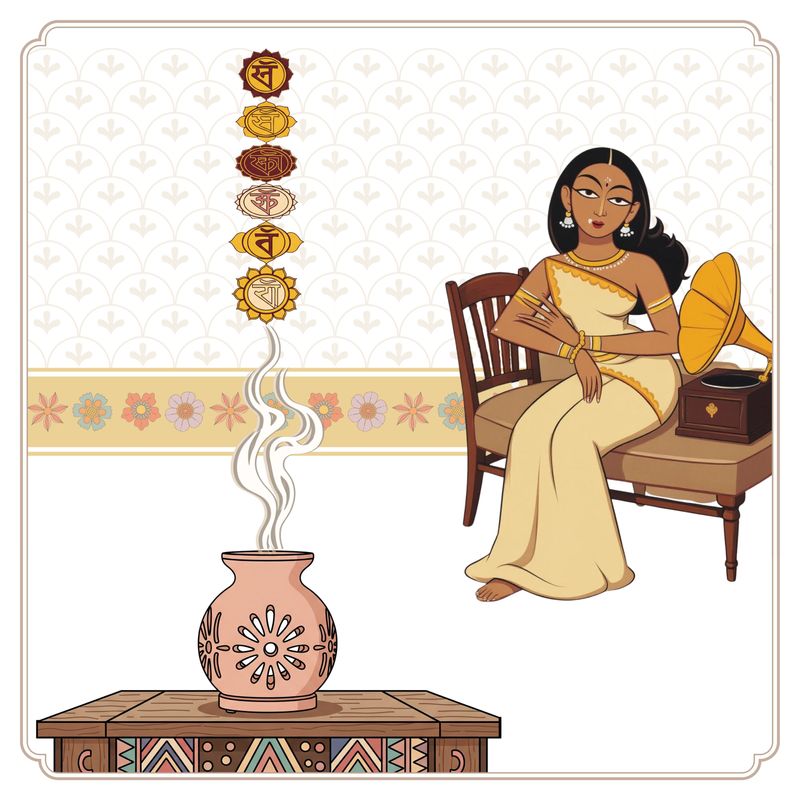
The origins of perfumery in the Indian subcontinent are inextricably linked with the evolution of sacred rituals and Vedic cosmology. Early documentation suggests that the manipulation of aromatic substances was initially not a pursuit of personal vanity, but rather a core component of sacrificial rites. The burning of aromatic woods, resins, and dried herbs during the yajna (fire ritual) served a dual purpose: it was believed to carry petitions to the deities whilst simultaneously purifying the terrestrial environment.
In the canonical texts, particularly the Rigveda, elements of nature possessing inherent fragrance—such as the sacred lotus and various forest resins—are elevated to symbols of divine presence. This spiritual foundation established a profound respect for the botanical world, laying the groundwork for sophisticated botanical classification. The transition from crude botanical offerings to distilled essences represented a significant leap in early chemical understanding, driven by the desire to capture the volatile purity of nature in a permanent, physical form.
Technical Sophistication in Classical Texts
As Indian civilisation advanced into its classical period, the art of scent extraction transitioned from empirical ritualism to a highly systematised discipline. The Gandhashastra, an ancient treatise dedicated entirely to the science of fragrance, outlines complex methodologies for the creation of perfumes, scented powders, and cosmetic pastes. This text, along with sections in Varahamihira’s Brihat Samhita dating to the sixth century, reveals a deep understanding of chemical processes such as distillation, sublimation, and fixation.
The Brihat Samhita details specific quantitative formulations for the manufacture of perfumes suitable for royal households. These formulas relied heavily upon a base of gandha-dravya (aromatic ingredients), which included sandalwood, vetiver (khus), agarwood (oud), and various floral waters. The texts underscore the importance of the blender’s skill, emphasizing that a master perfumer must understand the interaction of different ingredients to ensure the longevity of the scent profile without relying on artificial fixatives.
The Patronage of the Royal Courts: The Mughal Era
The refinement of Indian perfumery reached its historical zenith under the patronage of the royal courts, most notably during the Mughal Empire. The emperors and their consorts were connoisseurs of luxury, viewing fragrance as an essential element of statecraft, personal hygiene, and courtly etiquette. The Ain-i-Akbari, a detailed document of Emperor Akbar’s administration written by Abu'l-Fazl, contains an entire chapter dedicated to the royal khushboo khana (perfumery department).
"The court of the Emperor Akbar maintained a dedicated department for the formulation of bespoke fragrances, documenting expenditures on rare ingredients with the same precision applied to the imperial treasury."
During this era, the technique of deg-bhapka—a traditional hydro-distillation process—was perfected and widely deployed. Empress Nur Jahan is historically credited with popularising the discovery of the volatile oil of the rose, known as Ruh Gulab. This discovery was significant; it marked the transition to highly concentrated, oil-based distillates that did not utilize alcohol as a carrier, aligning perfectly with the climatic requirements of the subcontinent and the cultural preferences of the court. The royal courts of Awadh, Hyderabad, and Rajasthan similarly established their own distinct olfactive identities, fostering localized ecosystems of master distillers.
The Geography of Scent: Kannauj as the Olfactive Capital
Central to the narrative of modern Indian perfumery is the city of Kannauj, situated on the banks of the River Ganges. By virtue of its fertile alluvial soil and strategic position along historic trade routes, Kannauj established itself as the premier centre for the production of attar (or itirr). The city’s distillers preserved the ancient deg-bhapka method, resisting mechanical modernisation in favour of an empirical process that relies on clay vessels, bamboo pipes, and wood fires.
The significance of Kannauj lies not merely in its survival, but in its unique capability to capture complex environmental profiles. The most notable example of this artistry is Attar Mitti, a fragrance that captures the scent of the earth after the first monsoon rains. The process involves distilling baked clay tiles into a base of pure sandalwood oil. This particular formulation stands as a testament to the philosophical inclination of Indian perfumery: the desire to capture an ephemeral, transient moment of the natural world and render it permanent.
The Modern 'Attar' Bottle: Preservation and Contemporary Relevance
In the contemporary global marketplace, the traditional Indian attar bottle represents both a preserved heritage and a complex economic challenge. Genuine attar is characterized by its reliance on natural botanical bases, primarily sandalwood oil, which acts as a fixative for top notes such as jasmine, tuberose, or saffron. This reliance on natural raw materials distinguishes it sharply from Western fine perfumery, which heavily utilises synthetic aromatic chemicals and alcohol carriers.
The modern attar industry must navigate several critical factors:
Sourcing Constraints: The strict regulation of sandalwood harvesting in India has necessitated the exploration of alternative, sustainable base oils.
Global Standardization: Aligning traditional production methods with international cosmetic safety standards requires rigorous scientific validation without compromising heritage techniques.
Cultural Shifts: The evolution of consumer preferences demands that traditional olfactive profiles—often dense and linear—be adapted for contemporary, global audiences who favour lighter compositions.
The resilience of the attar bottle lies in its authenticity. It remains an unbroken link to a past where fragrance was viewed as an intellectual and spiritual science, rather than a mere commercial commodity. As global discourse increasingly values sustainability and natural provenance, the historical methodologies of Indian perfumery offer profound insights into the future of sustainable luxury.
Related Articles



Comments (0)
No comments yet. Be the first to share your thoughts!