
The Evolution of the 'Yagna'
The institutional practice of the Yajna serves as a critical mirror reflecting the philosophical and structural evolution of Indian civilization. Originating in the Vedic epoch as a communal, macrocosmic mechanism designed to maintain cosmic order (Rta) through rigorous reciprocal sacrifice, the ritual underwent a profound metaphysical transfiguration during the Upanishadic era. This phase prioritised the internalisation of the fire sacrifice, reframing it as a psychological and contemplative act. In the contemporary period, the Yajna has adapted to urban, globalised structures, transforming into compressed, individualised ceremonies that rationalise ancient ritualism through modern therapeutic and ecological frameworks.

Layashaktii
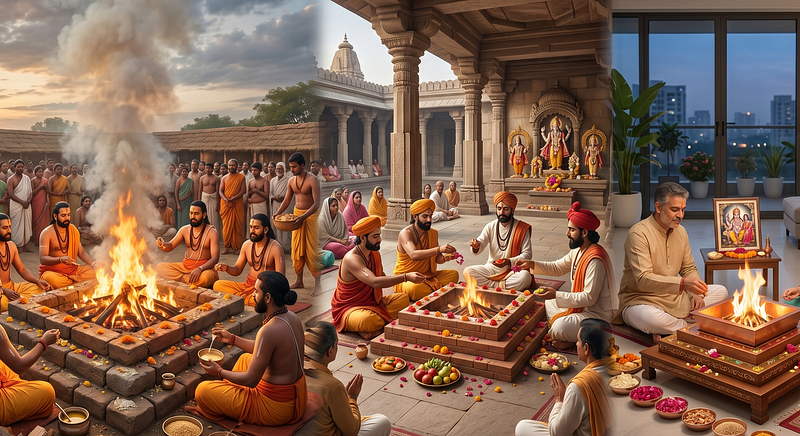
The institution of the Yajna (frequently transliterated as Yagna) stands as one of the most enduring pillars of the Indian ritual and philosophical landscape. Originating in the misty antiquity of the Vedic period, this ritual of the sacred fire has undergone thousands of years of metaphysical reinterpretation, structural adaptation, and social realignment.
To trace the evolution of the Yajna is to observe the broader trajectory of Indian civilization itself, moving from collective, cosmic responsibilities to deeply individualised, psychological practices in the contemporary era.
The Vedic Foundations: Cosmic Order and Collective Obligation
In its earliest manifestation, recorded within the Samhitas of the Rig Veda, the Yajna was primarily an external, communal act of sustenance. It operated on the principle of Rta—the cosmic, moral, and physical order that governs the universe.
The fire pit, or Kunda, served as a literal and symbolic portal to the divine realms. Agni, the deity of fire, was invoked as the priest of the gods and the messenger who conveyed human offerings—such as clarified butter, grains, and soma—to the celestial powers.
The Dynamics of Reciprocity
The early Vedic Yajna was defined by a strictly structured system of reciprocity between humanity and the deities. The sacrifices were not merely acts of passive worship; they were deemed essential to maintain the seasonal cycles, ensure rainfall, secure fertility, and preserve social harmony.
Scale and Specialisation
These ceremonies were monumental public events, often requiring months of preparation and the collective expertise of four distinct classes of priests:
The Hotri: Recited the invocations from the Rig Veda.
The Adhvaryu: Executed the physical actions and measurements of the altar based on the Yajur Veda.
The Udgatri: Chanted the melodic hymns of the Sama Veda.
The Brahman: Supervised the entire proceeding from the Atharva Veda, ensuring absolute precision and correcting errors in real-time.
The Upanishadic Shift: Internalisation and Metaphor
As Indian thought progressed into the first millennium BCE, a profound intellectual introspection challenged the absolute supremacy of ritual externalism. The Upanishads did not dismantle the Yajna, but rather transfigured its mechanics, moving the locus of sacrifice from the external fire pit to the internal landscape of the human being.
The Fire Within
The concept of Pranagnihotra emerged, wherein the acts of breathing and digestion were envisioned as internal offerings to the vital life force. The physical ingredients of the sacrifice were replaced by psychological attributes. Ego, sensory desires, and ignorance became the oblations, cast into the fire of self-knowledge (Jnana).
The Bhagavad Gita and Action as Sacrifice
This philosophical evolution achieved its synthesis in the Bhagavad Gita, where the definition of Yajna was broadened to encompass all selfless action. Lord Krishna categorises various forms of sacrifice, explicitly stating that the sacrifice of knowledge is superior to any material offering. Under this paradigm, performing one's duty without attachment to the results (Nishkama Karma) became the highest form of ritual.
The Medieval Integration: Puranic and Tantric Syntheses
The medieval period witnessed the democratization of ritual practice through the rise of the Puranic and Tantric traditions. The grand Vedic sacrifices, which required immense resources and specific caste lineages, gradually became impractical for a changing society.
During this era, the Yajna adapted by merging with Puja—the devotional worship of personal deities. The fire ritual was downscaled to fit within temple complexes and household shrines, becoming accessible to a wider demographic. The structural geometry of the Vedic altars was preserved, but the intent shifted toward generating personal merit (Punya), seeking divine protection, and expressing emotional devotion (Bhakti).
The Modern Transformation: Personalised and Ecocentric Ceremonies
In the contemporary era, the Yajna has undergone further reinvention to align with the rhythms of modern urban life, globalized sensibilities, and psychological needs. While institutional frameworks still conduct large-scale Yajnas for global peace or environmental well-being, the standard practice has become markedly individualised.
Compression and Convenience
Modern ceremonies are characterized by structural efficiency. The multi-day, elaborate rituals of antiquity have been compressed into brief, highly focused events lasting a few hours. These are frequently performed to mark personal milestones, such as the founding of a business, the purchase of a home, or familial anniversaries. The focus has shifted from sustaining cosmic order to seeking psychological reassurance and personal alignment.
Environmental Reinterpretation
A significant discourse in the modern survival of the Yajna revolves around ecological awareness. Modern proponents often frame the ritual as a therapeutic cleansing mechanism, arguing that the medicinal herbs, woods, and substances offered into the fire purify the immediate atmosphere. While modern scientific scrutiny offers mixed evaluations of these claims, the shift in rhetoric demonstrates a persistent desire to validate ancient metaphysics through contemporary scientific frameworks.
Conclusion
The historical journey of the Yajna reveals the remarkable resilience of Indian ritual traditions. By continuously modifying its scale, accessibility, and philosophical justification, the ritual of the sacred fire has avoided obsolescence. It remains a powerful cultural symbol, bridging the ancient cosmic anxieties of the Vedic rishis with the existential and psychological aspirations of the modern individual.
Related Articles



Comments (0)
No comments yet. Be the first to share your thoughts!