
Vastu Shastra for the Home Office: The Alignment of the Prosperity Desk
The integration of professional duties within the domestic sphere necessitates a structured approach to environmental design to sustain cognitive clarity and financial advancement. Grounded in the classical Indian architectural principles of Vastu Shastra, this study examines the spatial mechanics of the home office, prioritising the southwest quadrant for structural stability. It outlines the precise directional alignments—specifically facing north or east—required to optimise wealth accumulation and intellectual clarity. Furthermore, the text addresses elemental balancing through traditional instruments, including yantras and oil diffusers, alongside the conscious deployment of natural gemstones and bracelets to mitigate professional volatility and foster enduring prosperity.

Amolendu H.
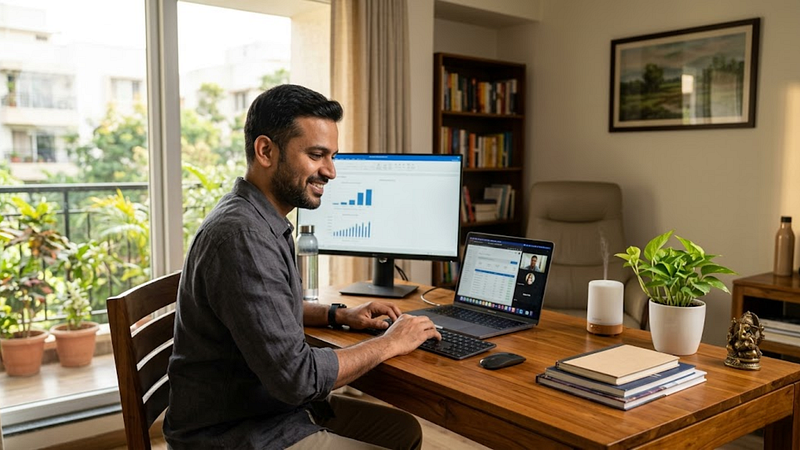
The contemporary expansion of remote work has fundamentally transformed the domestic landscape, requiring the integration of professional responsibilities within the traditional domestic sphere. This spatial convergence necessitates a rigorous re-examination of how environmental energies influence cognitive clarity, sustained productivity, and financial advancement. Traditional architectural wisdom, specifically the ancient principles of Vastu Shastra, provides a comprehensive framework for structuring these combined spaces to foster material growth and intellectual equilibrium.
In the classical Indian architectural tradition, a workspace is not merely a utilitarian arrangement of furniture; it is treated as a dynamic energetic system. When professional duties are conducted from the residence, the alignment of the desk becomes the central focus for regularising the flow of prosperity. By adhering to precise spatial laws, the remote professional can transform a standard desk into a functional center of sustained material advancement.
The Critical Importance of Desk Placement
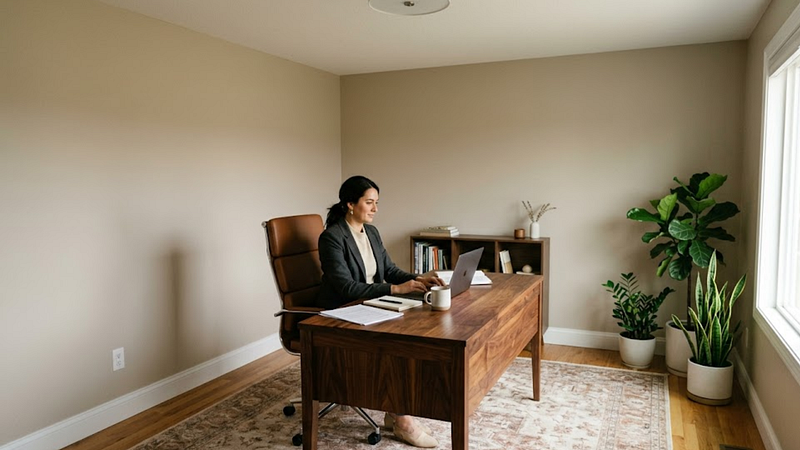
Within the architectural discipline of Vastu Shastra, the positioning of the primary workspace requires careful deliberation. The optimal location for a home office resides in the southwest sector of the residential layout. This quadrant, governed by the earth element, provides structural stability, psychological groundedness, and the authoritative focus necessary for executive decision-making. Positioned here, the professional establishes a firm foundation that protects against professional volatility and commercial instability.
Conversely, the desk itself must be positioned with precision within the designated room. It should ideally occupy the southwest corner of the office, ensuring that the occupant sits facing either the north or the east. The desk must never be placed directly flush against a wall; maintaining a distance of a few inches encourages the unimpeded circulation of energy, which in turn fosters innovative thought and professional evolution. Furthermore, positioning the desk directly beneath an exposed overhead beam must be strictly avoided, as this architectural configuration generates psychological pressure and induces cognitive fatigue.
Facing Directions and Financial Progression
The direction an individual faces whilst executing professional duties directly influences the subtle undercurrents of professional fortune. For remote workers seeking to increase their income, facing the north is highly recommended. The northern direction is governed by Kubera, the traditional custodian of wealth, and represents the element of water. Facing north introduces new commercial prospects, expands the client base, and facilitates the steady accumulation of capital.
For individuals whose professions demand creative synthesis, rigorous scholarship, or strategic leadership, facing the eastern direction is advantageous. The east, illuminated by the rising sun and presided over by Indra, stimulates intellectual clarity, innovation, and institutional recognition. Whether facing north for financial accumulation or east for intellectual growth, the professional must ensure that the view ahead remains clear and uncluttered, symbolising an unobstructed path toward future prosperity.
Elemental Balance and Spatial Rectification
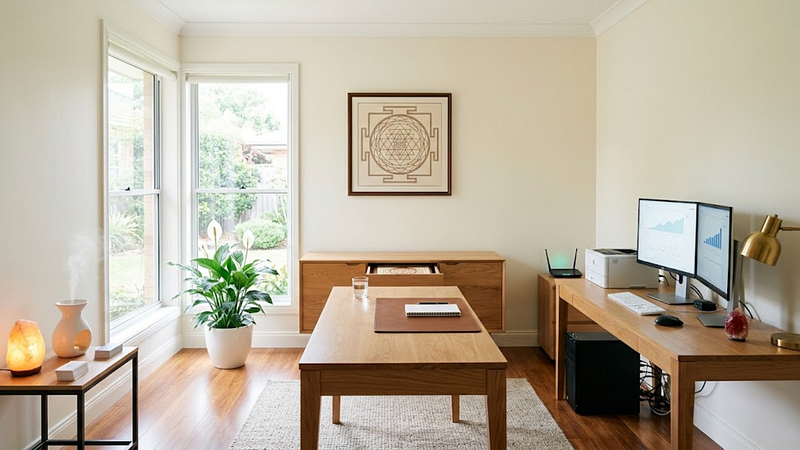
A harmonious home office depends upon the balanced distribution of the five fundamental elements. The northeast sector of the workspace represents the water element and must remain light, clean, and vacant of heavy storage units to permit the entry of auspicious opportunities. The southeast quadrant, representing the fire element, governs motivation, energy levels, and financial liquidity; hence, all electronic equipment, including computers, printers, and routers, should be organised within this specific zone.
To support these elemental alignments, specific traditional instruments may be integrated into the environment. The placement of a mathematically precise yantra on the northern wall or within a clean drawer serves to rectify structural imbalances and amplify prosperity. Similarly, incorporating a high-quality oil diffuser in the northwest sector introduces the air element, which refines communication, enhances professional networking, and preserves a tranquil working atmosphere.
Sacred Materiality and Conscious Enhancements
While correct spatial alignment forms the basis of Vastu compliance, the integration of specific materials can further support individual focus and energetic resilience. The presence of natural elements on or near the desk helps maintain environmental equilibrium during long hours of isolation.
A carefully selected gemstone, such as clear quartz or citrine placed in the northern corner of the desk, can aid in maintaining cognitive clarity and attracting commercial success. To support personal focus, wearing a natural bead bracelet on the right wrist can provide a grounding influence, helping the professional manage daily stress. These subtle additions complement the structural Vastu arrangements, creating a balanced and productive workspace.
The Structural Requirements of the Prosperity Desk
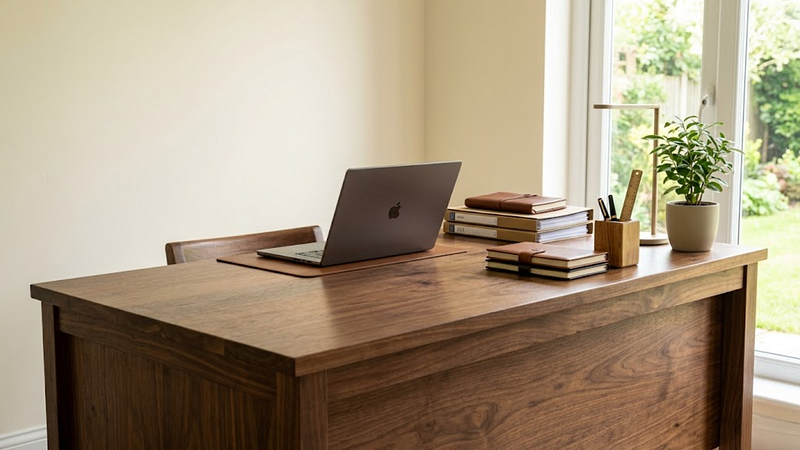
The physical characteristics of the desk itself heavily influence the professional atmosphere. Vastu principles state that the desk must be rectangular or square in shape. Irregular geometries, circular profiles, or L-shaped configurations introduce asymmetrical energy currents that can lead to inconsistent performance and financial uncertainty. The material composition should ideally be high-quality wood, which signifies growth and stability; metal or glass surfaces should be avoided, as they can cause erratic energetic fluctuations.
The surface of the prosperity desk must be kept clean and organised. A cluttered desk reflects an unsettled mind and impedes the flow of constructive opportunities. Documents should be systematically archived, and unnecessary items must be removed daily. The centre of the desk, known as the Brahmastan of the workspace, should be kept clear to allow analytical reasoning and creative insights to develop naturally.
Final Perspectives on Harmonious Productivity
The arrangement of a home office using Vastu Shastra is a methodical approach to environmental design, intended to harmonise professional activities with natural spatial laws. By selecting the correct position for the desk, facing the appropriate direction, and balancing the core elements, the remote professional can establish an environment that supports both productivity and financial growth. These traditional adjustments help transform the remote workspace into a reliable foundation for professional success and long-term prosperity.
Related Articles


Comments (0)
No comments yet. Be the first to share your thoughts!